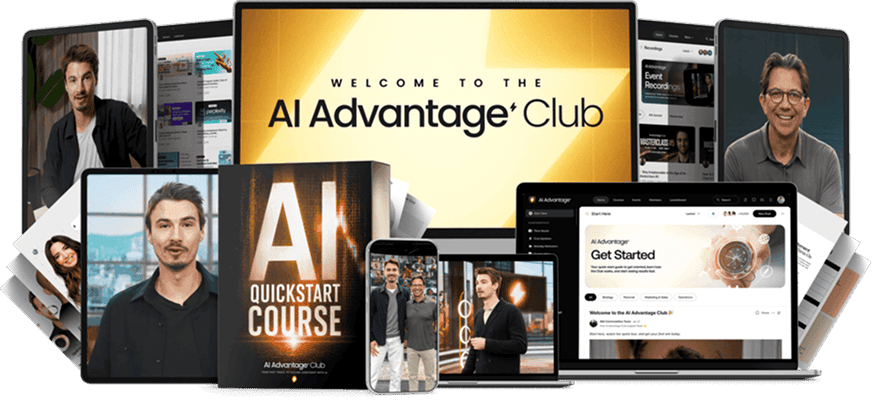
Part of a series on building a real working relationship with Claude. This one is about how it started: six weeks, a boot camp, and a clone of myself I didn't know I needed.
I signed up for the AI Advantage Bootcamp the way I've signed up for most things that mattered in my career: because I suspected I was behind and didn't like the feeling. I was mostly using ChatGPT and Claude as glorified search engines. The bootcamp is the six-week introduction to Igor Pogany's AI Advantage Club, hosted by Dean Graziosi and backed by Tony Robbins. One session a week, homework in between. It gave me the jumpstart I needed to break through my assumptions about how many areas of my life AI could improve.
Week 1: Clone Builder
The first session had one job: build a clone of yourself in one sitting. Not a metaphor. A real Claude Project, named "Erik's Clone," with a document in the instructions field called a Personal DNA: identity, background, goals for the next 90 days, my biggest win and my hardest lesson, the constraints and fears I usually don't put in writing, who I serve, and what "good" looks like when I get there.
The homework was the part that mattered. Go back through what I'd written and replace every vague line with a specific one. Not "I want financial freedom," but the actual thing underneath it. Not "I help business owners," but which ones, doing what, stuck where. Then I asked my own clone to write me a letter from one year in the future, referencing my specific goals and fears back to me. The first version felt like a fortune cookie. That was the signal the DNA still had generic answers hiding in it. I went back in, and the second letter sounded like something I'd want to receive.
That's also where I learned what a Project and its instructions are: not a chat that remembers a little more, but a place with a standing brief that loads every time, before I say a word.
Weeks 2 and 3: Activate and Accelerate
Week two was about turning a one-time DNA file into a daily habit. It started with a framework for what makes a prompt work: who you are, who it's for, what you want done, what format, what tone, who the AI should act as, and what success looks like. Then came seven days of using the clone for one real task a day, logging the time it took against how long it would have taken me alone. The tasks came straight from my day job: researching a partner contact, preparing a meeting brief, then writing the follow-up email afterward. By day four the log stopped being an exercise and started being proof.
Week three, Accelerate, was the voice week. The exercise: hand Claude three or more real samples of my own writing (an email, a post, an article) and have it reverse-engineer a Voice Skill file. That file covered how I open, how I close, the words I never use, the ones I reach for, a table of "instead of this, I write this" pulled straight from my own sentences, and a section on what my voice never does. That last part turned out to be the whole game. My anti-patterns list started there: no em dashes, no throat-clearing openers, no phrase that sounds like it came out of a call center. The homework pushed it further, having the clone interview me in three rounds (my story, what I believe, who I'm not for) until the DNA had a spine instead of just a bio.
I still use a version of that file today, on every piece of writing I put my name on.
Week 4: Augment
Week four moved from who I am to what I run: the Business DNA. Target market specific enough to be useless to anyone else's business, revenue range, positioning, the gap I fill, and a traffic-light rule for what's safe to share with an AI (mission and public content, green; revenue ranges and pricing philosophy, generalize; client names and contracts, never).
This is the one I didn't do alone. I built the Business DNA for Pet Companions Bed & Biscuit, my wife Laurel's dog boarding business, running it through both Claude and ChatGPT and comparing what came back. Two different reads on the same business turned out to be more useful than either one by itself. Once it was uploaded, I tested it the way the homework suggested: ask for ten specific actions ranked by impact, and see whether the answer felt like generic small-business advice or like something that knew the business. The first pass was generic. The second, after I'd gone back and made every vague line specific the way I'd learned in week one, was not.
Weeks 5 and 6: Automate and Scale
The back half of the boot camp is where automation stopped being a concept. Week five introduced Cowork, Claude's desktop environment for letting an agent work on files directly instead of just answering in a chat window, and walked through setting up a first scheduled task: a standing weekly brief that ran on its own. The homework was an audit, going through a normal week area by area (Monday routines, client work, content, admin) and marking each recurring task by whether an agent could realistically handle it.
Week six turned that audit into a build: a Skill, written from scratch with Claude's own skill-creator, plus a second scheduled task alongside the first. By the end of the boot camp I knew how to build a Skill. I never got one working in Claude chat. I had the vocabulary without a place for it to run, and I wouldn't find that place until a few months later, when I stopped chatting with Claude and started building with it in Claude Code.
Where it left me
By the end of six weeks I didn't have one clone. I had five. Erik's Clone from week one, plus a career development thread, a health thread, and separate threads for Pet Companions Bed & Biscuit and my job at the time. Each one had its own memory, its own DNA file, its own version of me that knew some things and not others.
That worked right up until it didn't. I'd have a good conversation in one project and want to reuse a piece of it somewhere else, and there was no bridge, just copy and paste, if I could even find the thing again. Artifacts piled up across threads with no shared index. When I started building ebrittwebb.com, I found myself downloading files out of one conversation just to hand them to another, manually carrying context that should have carried itself.
Six weeks in, I had learned more about working with AI than in the two years before it. I also had five separate versions of myself with no way to talk to each other, and a growing pile of downloaded files to prove it.
Next time: the weekend that broke that setup for good, and what my son said to me that sent me looking for something else entirely.