Part of a series on building a real working relationship with Claude. Last time: skills that run on a schedule, and the first drafts that now wait for me. This one is about the skill that makes those drafts sound like me.
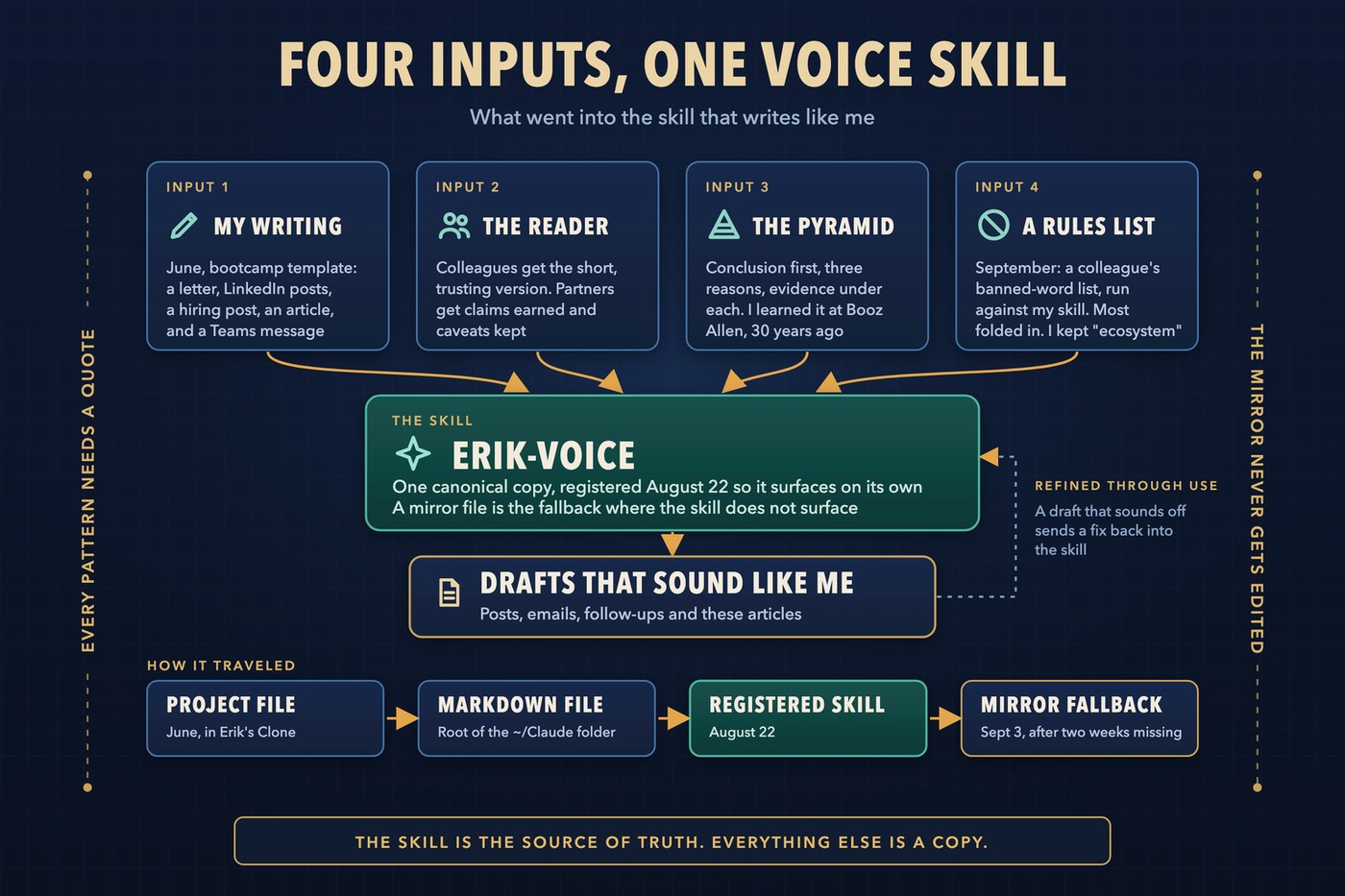
I built a Claude skill that writes like me. It took four moves over about three months, not one clean setup, and each move happened because the last one broke or fell short somewhere.
It started with a prompt, not a skill
In June 2026, week three of the AI Advantage Bootcamp handed me a template called "Accelerate: Train it in your voice." The prompt asked for at least three writing samples across different formats, the more variety the better, and it promised to turn them into a reusable voice guide. I fed it a personal letter, a couple of LinkedIn posts, a short job recruitment post, a long-form article, and an internal Teams message. Here is the prompt's structure in my own words. My skill still has this skeleton.
The prompt, in outline
AI Advantage Bootcamp, "Accelerate: Train it in your voice"
1. Setup. Analyze my writing and write a reusable voice skill file. I supply three or more samples in different formats, and it asks for more if I give fewer.
2. How to analyze. For each sample, look at structure, rhythm, word choices, personality, and what I never do. Evidence rule: every pattern needs a direct quote. Two or more samples make it a rule, and one makes it a tendency.
3. Output format. A fixed markdown file in seven parts: Core Identity; Voice Principles (five to eight, each with a one-sentence rule and an Instead of / Write table); Signature Patterns (how I open, how I close, transitions, analogies); Anti-Patterns (what my voice never does); Formatting and Language Rules; Format Adaptation; The Voice Check (three questions to test a draft).
4. Rules for the analysis. At least 15 Instead of / Write tables. Real phrases from my samples, never invented ones. Written as instructions to an AI, not a report about me. The file has to work on its own in any AI system.
Two of those instructions did the most work. The evidence rule kept the guide checkable, because every claim about my writing came with a quote I could verify. And the anti-patterns section, which the prompt marked as critical, told Claude what to avoid, since an AI falls back on generic habits unless told otherwise.
I ran it inside the Claude Project I'd set up in week one, Erik's Clone, and attached the resulting document as a project file. Any conversation inside that project could read it. That was the whole system for a while: one project, one file, one place to use it.
From a project file to a file on disk
When I moved more of my daily work into Claude Code, Erik's Clone didn't come with me automatically. The voice guide became a plain markdown file at the root of my ~/Claude folder, the umbrella project that now spans Skan, PCBB, and my personal work. Any session in that tree could read it if it knew to look.
Turning it into a skill, and losing it for two weeks
On August 22 I registered it as an actual Skill, so it would surface on its own instead of needing to be pointed at. The migration deleted the original flat file as part of the move. That part didn't fully work. The skill didn't reliably show up in every project's available-skills list. It went missing at different points in PCBB, in my Skan partner folders, and even in the root Claude folder itself. For about two weeks the voice guide was unreachable from parts of my own workspace, and I didn't know it until a session told me it couldn't find it.
The fix, on September 3, was to stop treating the skill registration as the only copy. I restored a mirror file at ~/Claude/erik_voice_skill.md, a guaranteed fallback findable by plain filesystem search regardless of whether the skill shows up in a given scope. The skill stayed canonical. The mirror gets re-synced from it after every edit, and never edited on its own, so the two don't drift apart.
I write differently to colleagues than to partners
Somewhere in here I noticed the guide was flattening something real. I don't write the same way to a Skan colleague as I do to a partner executive or a client. Internal messages skip the hedging, the disclaimers, the "please verify this before you use it." Colleagues get the short, trusting version because they already have context. External writing earns its claims more explicitly and keeps the caveats, because the reader doesn't have that context and more is riding on being right. That distinction became its own principle in the skill.
Minto Pyramid, almost 30 years later
I first learned the Minto Pyramid at Booz Allen Hamilton, close to thirty years ago: state the conclusion first, back it with three reasons, put the evidence under each. It's still the clearest way I know to structure a case for something, and I added it to the voice skill as the default shape for anything persuasive, an article, a client brief, a recommendation. That idea now has two helper skills, minto-pyramid and minto-diagnose. They came from two different places, and they deserve their own post.
A colleague's rules list, and what I kept
In September a colleague sent me a company-wide writing-rules doc, the usual banned-word and banned-phrase list aimed at making writing sound less like AI. I ran it against my own voice skill instead of just adopting it wholesale. Here is what went in, grouped the way the skill groups it.
Added to the skill on September 12
The Mechanical Bans section
Banned words. delve, tapestry, landscape (meaning "field"), realm, paradigm, synergy, leverage (as a verb), harness, utilize, robust, streamline, seamless, unlock, elevate, foster, underscore, pivotal, crucial, testament to, navigate (used figuratively), transformative, deep dive, load-bearing, gated, north star, table stakes.
Banned phrases. here's the thing, here's the kicker, here's what most people miss, the truth is, let's break this down, let's unpack, let's dive in, it's worth noting, importantly, notably, interestingly, that said, in conclusion, to sum up, at the end of the day, make no mistake, think of it as, imagine a world where.
Banned adverbs, the ones that fake significance. quietly, deeply, fundamentally, remarkably, arguably, genuinely, truly, actually, meaningfully.
Banned patterns.
- "It's not X, it's Y" sentences
- Three sentences in a row that start with the same word
- Decorative groups of three ("fast, efficient, and seamless"), and announcing "three reasons" or "here's why" before a list
- False ranges ("from X to Y to Z")
- "Serves as" or "represents" where "is" works
- Rotating synonyms for the same thing (dashboard, tool, platform)
- Coined labels for ordinary patterns ("the supervision paradox")
- "Experts say" or "studies show" with no named source
- Bolding the first words of every bullet
- Dramatizing a small point, or narrating my own process out loud
Most of it folded in cleanly. A few things didn't, and those were the interesting part.
The list banned "ecosystem." I build partner ecosystems for a living. Cutting it would have made me sound like I don't do my job. I kept it.
The list also banned rule-of-three padding: three adjectives when one would do, "here's why" before a list. That's a different thing from the Minto structure, which uses three reasons as the argument itself. I kept both rules and made sure they didn't read as contradicting each other. Three reasons is fine when it's the structure of the case, and never fine when it's just padding.
A few smaller things got refined rather than added or rejected. Headers switched from title case to sentence case. Fragments are still fine as a sentence inside a paragraph, just not as a whole paragraph standing alone for effect.
Next time: the two Minto skills, where each one came from, and why they do opposite jobs.